

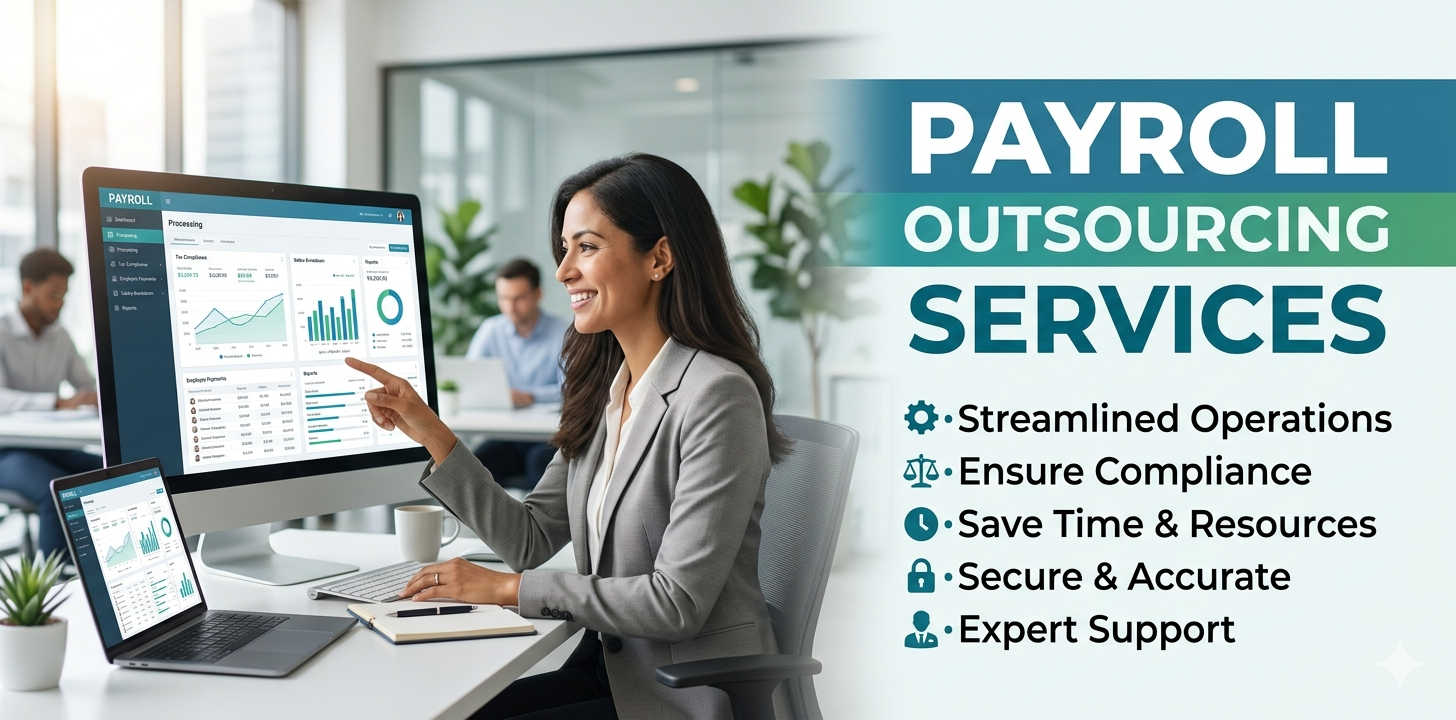
Running payroll sounds straightforward — until it isn’t. Tax codes change. Employees move states. A new hire joins mid-month. Before you know it, your team is buried in spreadsheets instead of building your business.
That’s exactly why more and more companies are turning to payroll outsourcing services — and why it might be the smartest operational decision you make this year.
In this guide, we’ll break down everything you need to know: what payroll outsourcing actually is, how it works step by step, the real benefits (and honest trade-offs), what it costs, and how to choose a provider that fits your business — not just the biggest name on a list.
What Are Payroll Outsourcing Services?
Payroll outsourcing services refer to the practice of hiring a third-party provider to manage some or all of your payroll functions — so your internal team doesn’t have to.
At its core, a payroll outsourcing company takes over tasks like:
- Calculating employee wages, overtime, and deductions
- Withholding and remitting payroll taxes (federal, state, and local)
- Filing quarterly and annual tax returns
- Processing direct deposits and issuing pay stubs
- Administering employee benefits deductions
- Handling year-end W-2 or 1099 preparation
- Staying current with changing labor and tax laws
In short, they take the entire administrative burden off your plate — and take legal and compliance responsibility for getting it right.
Quick stat: According to a 2025 survey by B2B Reviews, 69% of employers are actively planning to outsource most or all of their payroll within the next year.
How Does Payroll Outsourcing Work? (Step by Step)
Understanding the process takes away the mystery. Here’s what a typical payroll outsourcing engagement looks like:
Step 1: Discovery and Setup
Your provider gathers information about your workforce: employee count, pay schedules, benefit structures, state registrations, and any integrations needed (QuickBooks, Xero, Zoho, etc.). This usually takes 5–10 business days.
Step 2: Data Integration
Your existing HR and accounting software is connected to the provider’s payroll platform. Employee records, historical payroll data, and tax IDs are migrated securely.
Step 3: Payroll Processing
Each pay period, you submit or approve timesheets and any changes (new hires, terminations, salary updates). Your provider handles all the calculations — wages, deductions, taxes — and distributes payments via direct deposit.
Step 4: Tax Filing and Compliance
The provider files payroll taxes on your behalf — 941s, state withholdings, unemployment filings — on the correct schedule. They stay on top of regulatory changes so you don’t have to.
Step 5: Reporting and Review
You receive regular reports: payroll summaries, tax liability breakdowns, and audit-ready records. Most providers offer an employee self-service portal so your team can access pay stubs and tax documents anytime.
7 Genuine Benefits of Outsourcing Payroll Services
Let’s be honest — there’s a lot of generic content out there that says “payroll outsourcing saves time and money.” Let’s be more specific.
1. You Get Hours Back Every Pay Cycle
Managing payroll in-house requires constant attention: tracking hours, running calculations, double-checking deductions, and chasing missing information. For a 20-person company, this can easily eat 10–15 hours every pay period. Outsourcing hands all of that off.
2. Compliance Becomes Someone Else’s Problem
Payroll tax laws change constantly at federal, state, and local levels. The IRS collected approximately $2.8 billion in payroll-related penalties in 2024 alone — most of them from small businesses that simply didn’t know a rule had changed. A specialist provider tracks every change and keeps you on the right side of the law.
3. You Reduce Costly Errors Dramatically
In-house payroll teams juggling multiple responsibilities have a higher error rate than dedicated specialists. Outsourced providers using purpose-built software can bring that error rate down to around 1%.
4. Your Data Becomes More Secure
Payroll data is a prime target for fraud and identity theft. Reputable outsourcing providers use bank-level encryption, role-based access controls, two-factor authentication, and SOC 2 compliance to protect your employee data — standards that are difficult and expensive to replicate in-house.
5. You Scale Without the Headaches
Hiring your 50th employee shouldn’t mean rebuilding your payroll system from scratch. Outsourced services scale seamlessly — whether you add 5 employees or 500, the provider absorbs the additional complexity.
6. Costs Become Predictable
In-house payroll means salaries, software subscriptions, training, and overtime during busy periods. Outsourced payroll typically comes with a flat per-employee monthly fee — easier to budget, and often cheaper once you factor in the true cost of internal overhead.
7. Your HR Team Can Focus on People, Not Admin
When payroll is handled, your HR team gets back to what actually moves the needle: hiring, culture, performance, and retention.
What’s Included in Payroll Outsourcing Services?
Not all providers offer the same scope. Here’s what a full-service payroll outsourcing package typically covers — and what might be add-ons:
| Service | Typically Included | Sometimes Add-On |
|---|---|---|
| Payroll processing | ✅ | |
| Tax filing and remittance | ✅ | |
| Direct deposit | ✅ | |
| W-2/1099 preparation | ✅ | |
| Employee self-service portal | ✅ | |
| Benefits administration | ✅ | |
| HR compliance support | ✅ | |
| Time tracking integration | ✅ | |
| Onboarding/offboarding | ✅ | |
| Multi-state or international payroll | ✅ |
When evaluating providers, ask specifically what’s included in your quoted price — and what gets billed extra.
How Much Do Payroll Outsourcing Services Cost?
Pricing varies by provider, business size, and service scope. Here’s a realistic breakdown for 2026:
Traditional payroll services (ADP, Paychex, Gusto):
- $20–$150 per employee per month
- Plus per-payroll processing fees ($25–$80/run)
- Plus setup and year-end fees
Mid-market platforms (Rippling, Paycor, OnPay):
- $10–$50 per employee per month
- Often includes HR tools and integrations in base pricing
Offshore payroll specialists (dedicated professionals on your team):
- $18,000–$30,000 annually — regardless of employee count
- Best ROI for businesses with 20+ employees
- Full control, direct communication, and deep process integration
The hidden cost most people miss: When you calculate the true cost of in-house payroll — staff salary, software, training, error correction, and compliance penalties — outsourced payroll is almost always cheaper.
Payroll Outsourcing vs. In-House Payroll: A Real Comparison
| Factor | In-House Payroll | Outsourced Payroll |
|---|---|---|
| Cost | High (staff + software + training) | Predictable monthly fee |
| Compliance | Depends on team’s knowledge | Provider’s responsibility |
| Scalability | Requires hiring or rework | Scales automatically |
| Error rate | Higher (manual processes) | Lower (specialist + automation) |
| Data security | Depends on internal IT | Enterprise-grade controls |
| Time investment | 10–20 hrs/pay period | Near zero |
| Control | Full | Shared (you approve, they execute) |
For most businesses with more than 10 employees, the math almost always favors outsourcing.
What to Look for in a Payroll Outsourcing Provider
Choosing a provider is more than picking the biggest name. Here’s what actually matters:
1. Compliance Expertise
Ask about their process for staying current with federal, state, and local tax law changes. A good provider will have a dedicated compliance team and proactively notify you of changes that affect your business.
2. Software Integrations
Your payroll provider should work seamlessly with your existing tools — QuickBooks, Xero, Zoho, NetSuite, HubSpot, or whatever you use. Poor integrations create double-entry work and errors.
3. Data Security Standards
Look for SOC 2 Type II certification, GDPR compliance if you have international employees, two-factor authentication, and clear NDAs. Ask specifically who has access to your payroll data.
4. Clear SLA and Error Accountability
Who pays if a tax filing is late or incorrect? A reputable provider will put their accountability in writing — with clear SLA terms covering response times, error resolution, and compliance penalties.
5. Dedicated Support (Not a Call Queue)
When you have a payroll problem, you need an answer fast — not a ticket number. Look for providers who offer a named account manager, not just a generic support line.
6. Scalability for Where You’re Headed
Think 12–24 months ahead. If you’re planning to hire internationally or expand to new states, make sure your provider can grow with you — before you’re locked into a contract.
7. Transparent Pricing
Get a full pricing breakdown before signing anything. Ask specifically about setup fees, per-payroll run charges, year-end fees, and what happens if you increase headcount.
Common Mistakes Businesses Make When Outsourcing Payroll
Even great businesses make these errors:
Choosing on price alone. The cheapest provider often has the weakest compliance support. One IRS penalty can cost more than a year of a premium service.
Not defining scope clearly. Assuming benefits administration is included when it isn’t creates gaps that affect employees.
Skipping the security review. Don’t hand over sensitive employee data without verifying the provider’s security certifications.
Not planning the transition. Switching payroll mid-year is doable, but requires clean data migration and a parallel-run period. Plan it properly.
Ignoring the SLA. If there’s no written accountability for errors or delays, you have no recourse when something goes wrong.
Is Payroll Outsourcing Right for Your Business?
Here’s a simple framework:
Outsource payroll if:
- You’re spending more than 5 hours per pay period on payroll admin
- You’ve had compliance issues, late filings, or penalty notices
- You’re growing headcount and payroll complexity is increasing
- You operate in multiple states or countries
- Your HR team spends more time on payroll than on people strategy
Keep payroll in-house if:
- You’re a solo founder or very early-stage (1–3 employees)
- Your payroll is extremely simple and unchanging
- You have a dedicated, certified payroll professional on staff
For most small to mid-sized businesses — especially those scaling — outsourcing is the smarter move.
Why an Offshore Payroll Team Might Be Your Best Option
There’s a growing middle ground between traditional payroll software and full-service domestic providers: dedicated offshore payroll specialists.
Instead of paying premium rates to large vendors, companies like FinServe Global help you hire, train, and manage skilled payroll professionals in Nepal — who work exclusively for your company, integrate into your existing workflows, and operate across US, EU, and Gulf time zones.
The result: the control and deep process knowledge of an in-house team, at a fraction of the cost.
- No setup fees
- No per-employee pricing
- Full integration with your existing tools (QuickBooks, Xero, Zoho, and more)
- Dedicated account coordination
- Security-first: NDAs, 2FA, VPN access, and audit trails
For businesses spending $1,500–$5,000/month on traditional payroll services, this model often delivers the same quality output at 40–60% lower cost.
Frequently Asked Questions
What is the difference between payroll outsourcing and a PEO? A payroll outsourcing provider handles only payroll functions. A Professional Employer Organization (PEO) enters a co-employment relationship and takes on broader HR responsibilities — benefits, workers’ comp, compliance. Payroll outsourcing is simpler and gives you more control.
How long does it take to set up outsourced payroll? Most providers can have you fully operational in 7–14 days. At FinServe, we’re typically live within 7 days of the initial consultation.
Will I lose control of my payroll data? No — you retain full ownership of your data. You approve every payroll run. The provider executes, files, and reports. You should always have access to your records and the ability to export them.
Can I outsource payroll mid-year? Yes, though it requires clean data migration. Your provider should handle the transition and run parallel processing to verify accuracy before fully switching over.
What happens if the provider makes a mistake? A reputable provider will cover any penalties resulting from their errors. Get this in writing in your service agreement.
Is payroll outsourcing only for large companies? Not at all. In fact, small and mid-sized businesses benefit the most — they gain enterprise-level compliance and expertise without the overhead of a dedicated in-house payroll team.
The Bottom Line
Payroll outsourcing services aren’t just a cost-cutting exercise — they’re a way to buy back time, reduce risk, and give your team the bandwidth to focus on growth.
The best providers aren’t necessarily the biggest ones. The best provider is one that fits your workflow, communicates clearly, takes compliance seriously, and grows with you.
If you’re ready to stop spending hours on payroll admin every month — and hand it off to a team that does this every day — FinServe Global is ready to help.
No setup fees. Monthly plans available. Live within 7 days.
FinServe Global provides BPO services including payroll outsourcing, accounting, HR, and tech support. Our Nepal-based team works seamlessly across US, EU, and Gulf time zones.
SHARE ON