
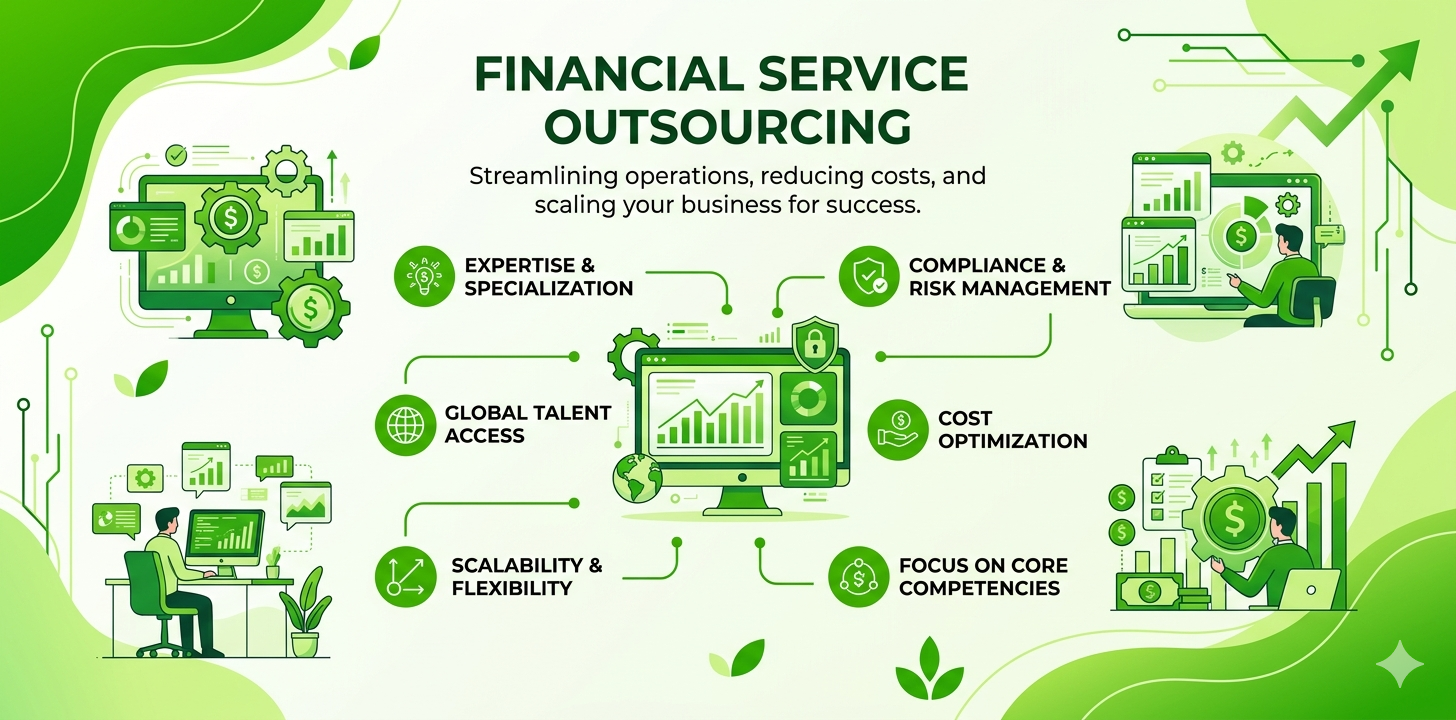
The finance and accounting outsourcing market is projected to reach $59 billion in 2026, growing at 7.78% annually — and it’s not large enterprises driving that growth. It’s SMBs, scale-ups, and mid-market firms that are quietly replacing expensive in-house finance teams with skilled external partners. Financial ser-vice outsourcing is now one of the fastest strategic decisions a growing business can make.
Financial service outsourcing is defined as the practice of delegating finance and accounting functions — such as bookkeeping, payroll, tax preparation, and fi-nancial reporting — to an external provider rather than employing dedicated in-house staff. The result: lower overhead, faster reporting, and access to exper-tise that would otherwise cost two to three times more to build internally.
In this guide, you’ll learn exactly what financial service outsourcing covers, the specific functions you can hand off today, the real benefits (backed by current data), the risks to weigh, and how to evaluate a provider so you don’t end up with a bad hire at scale.
What Is Financial Service Outsourcing?
Financial service outsourcing is defined as any arrangement in which a busi-ness contracts a third-party provider to manage finance-related functions that would otherwise be handled by in-house employees. These arrangements range from a single bookkeeper handling monthly reconciliations to a fully outsourced finance department managing everything from accounts payable to regulatory compliance and financial planning.
According to research by Mordor Intelligence, approximately 90% of US Chief Financial Officers have adopted some form of accounting outsourcing, reflecting how mainstream the practice has become. Outsourcing is no longer a cost-cutting last resort — it is a deliberate operational strategy.
Financial Service Outsourcing vs. Hiring In-House
Financial service outsourcing is defined as any arrangement in which a busi-ness contracts a third-party provider to manage finance-related functions that would otherwise be handled by in-house employees. These arrangements range from a single bookkeeper handling monthly reconciliations to a fully outsourced finance department managing everything from accounts payable to regulatory compliance and financial planning.
According to research by Mordor Intelligence, approximately 90% of US Chief Financial Officers have adopted some form of accounting outsourcing, reflecting how mainstream the practice has become. Outsourcing is no longer a cost-cutting last resort — it is a deliberate operational strategy.
Financial Service Outsourcing vs. Hiring In-House
The core distinction is ownership of overhead. When you hire an in-house fi-nance employee, you absorb recruitment costs, salary, benefits, training, soft-ware licenses, and the risk of turnover. When you outsource, you pay a service fee — and the provider absorbs all of that operational burden. According to the IAOP 2023 Global Outsourcing Report, companies report average cost savings of 15–30% through outsourcing, with offshore engagements deliv-ering savings of 40–60% in operational costs compared to equivalent in-house functions.
What Financial Services Can Be Outsourced?
Financial service outsourcing covers a wide range of functions — from routine transactional work to high-level strategic advisory. The most commonly out-sourced finance services include: bookkeeping and general ledger management, accounts payable and accounts receivable, payroll processing and compliance, bank reconciliation, tax preparation and VAT administration, financial report-ing and management accounts, and fractional CFO or controller services.
A 2025 industry survey found that 42% of firms outsource accounting and bookkeeping — making it the most outsourced financial function. Payroll and tax compliance follow closely, with 37% of businesses seeking outsourced solutions for these tasks (MicroSourcing / CSVNow data).
Back-Office vs. Strategic Outsourcing
Back-office outsourcing handles the operational layer: data entry, reconcil-iations, invoice processing, payroll runs, and ledger updates. These are high-volume, rules-based tasks where accuracy matters more than strategic input. Strategic outsourcing refers to higher-value functions: financial planning and analysis (FP&A), cash flow forecasting, budget modelling, compliance oversight, and fractional CFO engagements. Many businesses begin with back-office out-sourcing and expand into strategic services once trust is established with a provider.
6 Key Benefits of Financial Service Outsourcing
The primary benefit of financial service outsourcing is cost reduction without sacrificing quality — businesses that outsource financial operations report a 25% average improvement in operational efficiency within the first year, according to market analysis published by Market Reports World. But cost is only one dimension of the value. Here are the six benefits that matter most.
Cost Savings
Outsourcing eliminates the overhead that inflates in-house finance costs: job advertising, recruitment, onboarding, training, payroll taxes, benefits, and turnover coverage. For offshore engagements — such as Nepal-based teams working with North American or European clients — labour cost differentials can reduce your finance function spend by 40–60% compared to equivalent domestic hiring, according to Mordor Intelligence’s Finance and Accounting Outsourcing Market Report 2025.
Access to Expert Talent
When you hire a single in-house bookkeeper, you get the skills of one person. When you outsource to a specialist provider, you get access to a team that includes CPAs, payroll specialists, compliance experts, and ERP-trained ac-countants — all managed by the provider. The global accountant workforce in the US declined by approximately 10% between 2019 and 2024 due to retirements and a shrinking talent pipeline. Financial service outsourcing lets businesses bypass this domestic shortage entirely.
Scalability
Outsourced finance teams scale with your workload. A seasonal business that processes 500 invoices in Q4 and 80 in Q1 pays accordingly — it does not carry the fixed cost of a full-time team year-round. According to The Hackett Group’s 2024 Global Outsourcing Effectiveness Report, outsourcing empowers businesses
to adjust resources up or down rapidly, something an in-house team cannot offer without redundancy costs or hiring delays.
Improved Compliance
Regulatory complexity is growing. Basel IV, IFRS 17, GDPR, ESG disclosure requirements, and jurisdiction-specific payroll laws all demand ongoing specialist knowledge. A dedicated outsourcing partner whose livelihood depends on stay-ing current will reliably outperform an in-house generalist who handles compli-ance alongside fifteen other responsibilities. The Financial Stability Board notes that outsourcing compliance functions to specialized providers significantly re-duces the operational risk of regulatory breaches for regulated entities.
Faster Reporting and Real-Time Visibility
Cloud-based accounting platforms — including Xero, QuickBooks, NetSuite, and SAP — combined with outsourced finance teams create real-time financial dashboards. Rather than waiting for a monthly management accounts pack, business owners receive live visibility into cash position, accounts receivable ag-ing, and expense tracking. According to ContinuServe’s 2025 outsourcing trends analysis, in 2024, 40% of CFOs planned to outsource more work specif-ically to gain access to real-time financial data they couldn’t generate internally.
Focus on Core Business Growth
Every hour your leadership team spends on reconciliations, payroll queries, and invoice chasing is an hour not spent on sales, product, or strategy. Outsourc-ing frees up internal resources — Deloitte’s 2024 Global Outsourcing Survey found that businesses that outsource non-core tasks reinvest an average of 12% more into innovation and R&D than those managing equivalent functions in-house.
Risks to Consider Before You Outsource
Financial service outsourcing introduces risks that should be assessed before signing any contract. The three primary concerns are data security, communi-cation quality, and provider dependency.
Data security is the most cited concern. Finance data is sensitive — it includes payroll records, tax filings, bank statements, and customer billing information. A credible outsourcing provider will operate under least-privilege access controls, two-factor authentication, encrypted data transfers, and role-based permissions. Ask for a written security policy and request evidence of compliance with rel-evant standards (SOC 2, ISO 27001, or equivalent). According to IBM’s Cost
of a Data Breach Report, the average breach now costs $4.9 million — vendor due diligence is not optional.
Communication and time zone alignment must be explicitly managed. Define response time SLAs, establish a dedicated point of contact, and agree on reporting cadences before work begins. A provider whose team overlaps with your operating hours eliminates the most common pain point.
Provider dependency — the risk that operational knowledge becomes locked inside the outsourcing firm — is mitigated by requiring documented SOPs, main-taining read access to all financial systems, and retaining at least one internal stakeholder who understands the outsourced processes.
How to Choose the Right Financial Service Outsourcing Partner
Choosing the right financial service outsourcing partner requires evaluating seven criteria. A provider who scores well across all seven will reduce cost and risk simultaneously:
- Domain specialisation — Does the provider have certified accountants (CPAs, ACCAs, or equivalent) who work specifically in your industry or jurisdiction?
- Security framework — Can they provide a written security policy, evi-dence of 2FA enforcement, and data handling procedures?
- Technology stack — Do they work on your existing accounting platform (Xero, QuickBooks, NetSuite), or will they require a migration?
- Onboarding speed — How quickly can a new client become operational? Best-in-class providers deliver value within 5–7 days.
- SLA transparency — Are turnaround times, accuracy standards, and escalation procedures written into the contract?
- Scalability model — Can they add capacity quickly? Can they provide backup coverage if a team member is unavailable?
- References and proof — Can they provide verifiable client references or case study data showing measurable outcomes?
According to a 2025 outsourcing buyer survey, 89% of companies say indus-try experience is the most important factor when selecting an outsourcing provider, followed by data privacy practices (84%) and demonstrated cost sav-ings (76%).
Why Businesses Choose Nepal-Based BPO for Financial Outsourcing
Nepal has emerged as a high-quality, cost-competitive outsourcing destination that offers a specific set of advantages over more saturated markets like India and the Philippines.
Time zone coverage: Nepal Standard Time (UTC+5:45) overlaps meaning-fully with North American mornings, full European business hours, and Middle Eastern schedules — giving clients in all three regions a real working-hours overlap without the lag that purely offshore arrangements create.
Labour cost efficiency: Equivalent finance professionals in Nepal cost 50–70% less than US or UK equivalents, while holding internationally recognised qualifications and working in English. This gives clients the 40–60% cost savings of offshore outsourcing without the communication friction that some other destinations introduce.
Vetting and management: At FinServe Global, every finance professional goes through identity verification, background checks, NDA signing, and skills assessment before joining a client team. Secure devices, endpoint encryption, role-based access, and 2FA are standard. Clients receive weekly performance reports and retain full visibility into their financial systems at all times.
For businesses looking to outsource accounting, payroll, HR back-office, or finan-cial reporting, FinServe Global provides dedicated teams that onboard in 5–7 days, operate on your existing tools, and integrate seamlessly into your workflow
The Bottom Line
Financial service outsourcing is no longer a strategy reserved for large corpo-rations. Growing businesses — from funded startups to established SMBs — are using outsourced finance teams to cut costs by 40–60%, eliminate recruit-ment headaches, and access expert accountants who deliver accurate, compliant financial management from day one.
The key is choosing a provider with the right combination of finance expertise, security controls, and genuine operational integration — not just a freelancer marketplace or a vendor who hands you a spreadsheet once a month.
FinServe Global provides dedicated, vetted finance teams based in Nepal — working on your tools, in your time zone, with no setup fees and flexible monthly plans. Book a free consultation to see how we can reduce your finance overhead and give you back the time to focus on growth.
Frequently Asked Questions
Financial service outsourcing is the practice of contracting an external provider to handle finance and accounting functions — such as bookkeeping, payroll, tax preparation, accounts payable and receivable, and financial reporting — in-stead of employing dedicated in-house staff. The arrangement reduces overhead, provides access to specialist expertise, and allows businesses to scale finance ca-pacity without adding headcount.
The most commonly outsourced financial services include bookkeeping, accounts payable and receivable management, payroll processing, bank reconciliation, tax preparation, VAT administration, financial reporting, and fractional CFO or controller services. Back-office transactional functions are most frequently out-sourced first, with strategic services like financial planning and analysis following once a provider relationship is established.
The cost of financial service outsourcing depends on the scope of services, the se-niority of professionals required, and the provider’s location. Offshore providers particularly in Nepal, India, and the Philippines — typically deliver cost sav-ings of 40–60% compared to equivalent in-house hiring in the US or UK. A dedicated bookkeeper through a Nepal-based BPO like FinServe Global typi-cally costs a fraction of the equivalent domestic salary, with no recruitment, training, or benefits overhead. Contact FinServe Global for a customised quote based on your specific requirements.
Financial service outsourcing is safe when the provider operates robust data security controls. Look for providers that enforce role-based access, two-factor authentication, encrypted data handling, and signed NDAs with all staff. Rep-utable providers will also maintain audit trails and offer regular security report-ing. According to the Financial Stability Board, regulated entities can effectively manage outsourcing risks through comprehensive risk management programmes and clearly written contracts that define data handling obligations.
Business Process Outsourcing (BPO) is the broader category — it refers to outsourcing any business process, including HR, IT, customer service, and mar-keting. Outsourced accounting is a specific subset of BPO focused exclusively on finance and accounting functions. A BPO provider like FinServe Global may offer outsourced accounting alongside HR, payroll, and tech support, giving clients a single partner for multiple back-office functions rather than managing multiple specialist vendors.
With a well-structured provider, onboarding takes 5–7 business days. Day 0–2 typically covers discovery — understanding your existing workflows, tools, and reporting requirements. Days 3–5 cover setup: access provisioning, SOP documentation, and process mapping. By day 6–7, the outsourced team is op-erational and producing work. FinServe Global’s four-stage onboarding process (Discover → Select → Onboard → Ongoing) is designed to deliver measurable value within the first week, with no setup fees.
SHARE ON