

In today’s globalized economy, businesses are constantly seeking ways to optimize operations, reduce costs, and enhance efficiency. One strategy that has gained significant traction is offshore accounting—a practice where companies outsource their financial management tasks to professionals located in other countries. This approach not only leverages international talent pools but also capitalizes on economic differences to deliver high-quality services at a fraction of the cost of in-house teams.
Offshore accounting encompasses a wide range of services, including bookkeeping, payroll processing, tax preparation, financial reporting, and compliance management. As businesses expand internationally or face talent shortages domestically, offshore solutions provide scalability and flexibility. According to industry experts, companies can achieve up to 70% cost savings through this model, allowing them to redirect resources toward core activities like innovation and customer engagement.
What Is Offshore Accounting?
At its core, offshore accounting refers to the delegation of accounting and financial tasks to third-party providers or teams based in foreign countries. This is distinct from traditional outsourcing, as it often involves leveraging locations with lower labor costs, favorable time zones, and specialized expertise. For instance, a U.S.-based company might partner with accountants in Nepal or India to handle daily bookkeeping, while benefiting from round-the-clock productivity due to time differences.
The term “offshore” originated from financial practices in tax havens like the Cayman Islands, but modern offshore accounting is more about operational efficiency than tax avoidance. It includes services such as:
- Bookkeeping: Recording daily transactions, reconciling accounts, and maintaining ledgers.
- Payroll Management: Processing employee salaries, deductions, and compliance with local labor laws.
- Tax Preparation and Compliance: Ensuring adherence to international tax regulations, including filings for cross-border operations.
- Financial Reporting: Preparing balance sheets, income statements, and cash flow analyses.
- Auditing Support: Assisting with internal audits and regulatory audits.
Unlike onshore accounting, where everything is handled domestically, offshore models use remote teams integrated via cloud-based tools like QuickBooks, Xero, or NetSuite. This setup allows seamless collaboration, with data stored securely in the cloud to mitigate geographical barriers.
A unique insight here is the evolution of offshore accounting in the post-pandemic era. With remote work normalized by 2026, businesses are increasingly viewing offshore teams not as distant vendors but as extensions of their in-house staff. This shift has led to hybrid models where onshore strategists oversee offshore executors, fostering innovation in financial processes.
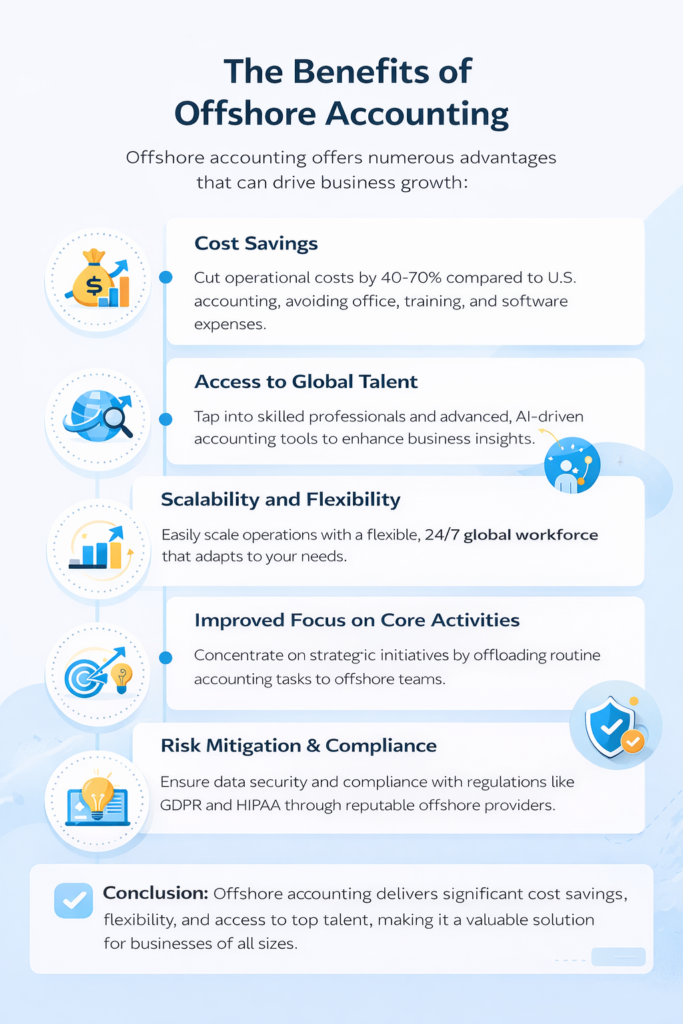
The Risks and Disadvantages of Offshore Accounting
While the advantages are clear, offshore accounting isn’t without challenges. Understanding these risks is crucial for informed decision-making.
- Data Security and Privacy Concerns: Handling sensitive financial data remotely raises cybersecurity risks. Breaches could lead to identity theft or financial loss. To mitigate, choose providers with ISO certifications and regular audits.
- Communication and Cultural Barriers: Language differences or cultural nuances can cause misunderstandings. Time zones might delay responses, though tools like Slack and Zoom help bridge gaps.
- Compliance and Legal Risks: Offshore setups must comply with home-country laws, such as U.S. IRS reporting for foreign transactions. Tax implications include potential double taxation or scrutiny for evasion, though legitimate setups are fully legal.
- Quality Control and Turnover Issues: Not all providers maintain high standards; high turnover in some regions can disrupt continuity. Vet partners thoroughly to avoid subpar work.
- Dependency on Technology: Reliance on internet and cloud tools means outages could halt operations. Backup systems are essential.
A unique insight: In 2026, with advancing blockchain for secure transactions, many risks are diminishing, but businesses must still prioritize due diligence.
Legal and Tax Considerations in Offshore Accounting
Navigating the legal landscape is vital for successful offshore accounting.
Is Offshore Accounting Legal?
Yes, as long as it adheres to tax laws and avoids illicit activities like money laundering. U.S. businesses, for example, must report foreign accounts via FATCA.
Tax Implications
Offshore setups can offer tax benefits through treaties, but evasion is illegal. Businesses face implications like transfer pricing rules and withholding taxes. Consult experts to optimize legally.
Regulatory Compliance
Adhere to standards like SOX for public companies. International data protection laws (e.g., GDPR) apply to cross-border data.
Unique perspective: Emerging regulations in 2026 emphasize transparency, with AI tools aiding automated compliance checks.
How to Set Up Offshore Accounting for Your Business
Setting up offshore accounting requires a structured approach.
Step 1: Assess Your Needs
Identify tasks to offshore—start with non-core functions like bookkeeping.
Step 2: Research and Select a Provider
Evaluate providers based on expertise, reviews, and tools. Look for those offering scalable teams.
Step 3: Establish Contracts and SLAs
Define scopes, timelines, and KPIs in agreements.
Step 4: Onboard and Train
Integrate teams with training on your systems.
Step 5: Monitor and Optimize
Use dashboards for performance tracking and regular audits.
Best practices include clear communication and cultural training.
Case Studies: Real-World Success with Offshore Accounting
Case Study 1: A Small CPA Firm’s Growth
A Texas-based CPA firm doubled its client base by offshoring bookkeeping, reducing costs by 30% and improving turnaround times.
Case Study 2: Tech Startup Efficiency
A startup saved 50% on accounting by using offshore teams for payroll, allowing focus on product development.
Case Study 3: Nonprofit Operational Boost
The Design-Build Institute of America enhanced efficiency through offshore finance outsourcing.
These examples highlight tangible ROI from offshore strategies.
Why Finserve Global Is the Best Solution for Your Offshore Accounting Needs
When selecting an offshore accounting provider, Finserve Global stands out as the premier choice for businesses worldwide. Based in Kathmandu, Nepal, Finserve Global offers comprehensive BPO services tailored to finance and accounting, making it an ideal partner for offshore bookkeeping and financial management.
Finserve Global specializes in accounting BPO, handling everything from bookkeeping and accounts payable/receivable to payroll processing and financial reporting. They are proficient in popular tools like QuickBooks, Xero, NetSuite, and Zoho, ensuring seamless integration with your existing systems. What sets them apart is their commitment to data security—employing encryption, role-based access, and continuous audits to protect sensitive information.
Their scalable model allows you to start with one dedicated bookkeeper or build a full team, all while benefiting from time zone overlaps with North America, Europe, and the Middle East for efficient collaboration. Beyond accounting, they provide HR outsourcing, IT support, and even grant filing assistance, offering a one-stop solution for back-office needs.
Clients praise Finserve for reducing overheads, ensuring compliance, and enabling data-driven decisions through expert financial analysis. Whether you’re a startup or an established firm, Finserve Global will be the best solution for your offshore accounting needs, delivering reliability, expertise, and growth-focused support.
Conclusion: Embracing Offshore Accounting for Future Success
Offshore accounting is more than a cost-cutting tool—it’s a strategic enabler for business growth. By understanding its benefits, mitigating risks, and following best practices, companies can achieve financial excellence. As we’ve seen, providers like Finserve Global exemplify how offshore solutions can transform operations.
If you’re ready to optimize your finances, consider offshore accounting today. With proper implementation, it could be the key to unlocking your business’s full potential in 2026 and beyond.
SHARE ON